Has your dentist recommended a crown?
If a crown was on your last treatment plan, there is a good chance you were sold on the convenience of a “same day” or “same appointment” procedure. The technology is impressive. The marketing is everywhere. What rarely gets said out loud is this: same-day crowns are quick and profitable for the dental office, especially with new chairside milling units to pay off.
This overused procedure is not conservative. It is not conscientious. And it is not compassionate.
No matter your age, a dental crown is one of the most destructive things you can do to a healthy tooth, and it often leads to bigger problems later in life. There are absolutely real reasons for a crown. The issue is that crowns are horribly over-prescribed. In most cases, they are overkill for the problem you actually have, and many insurance-based practices have learned the fastest path to revenue is to recommend a crown instead of a more conservative option that insurance does not reimburse well.
If you are looking for less damaging dental care, options that are more conservative, conscientious, and compassionate, you owe yourself a second opinion before that drill starts.
The short answer
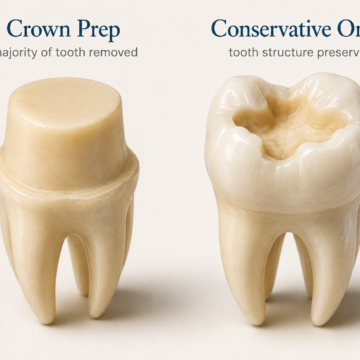
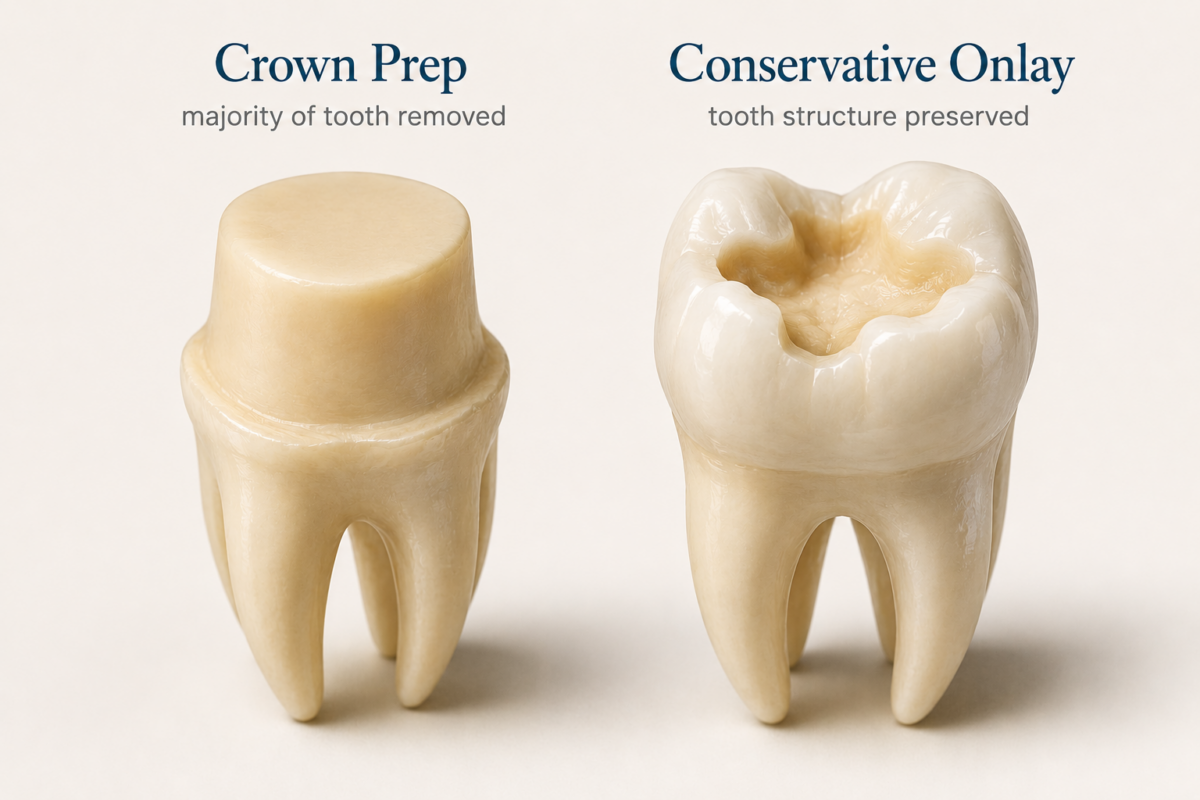
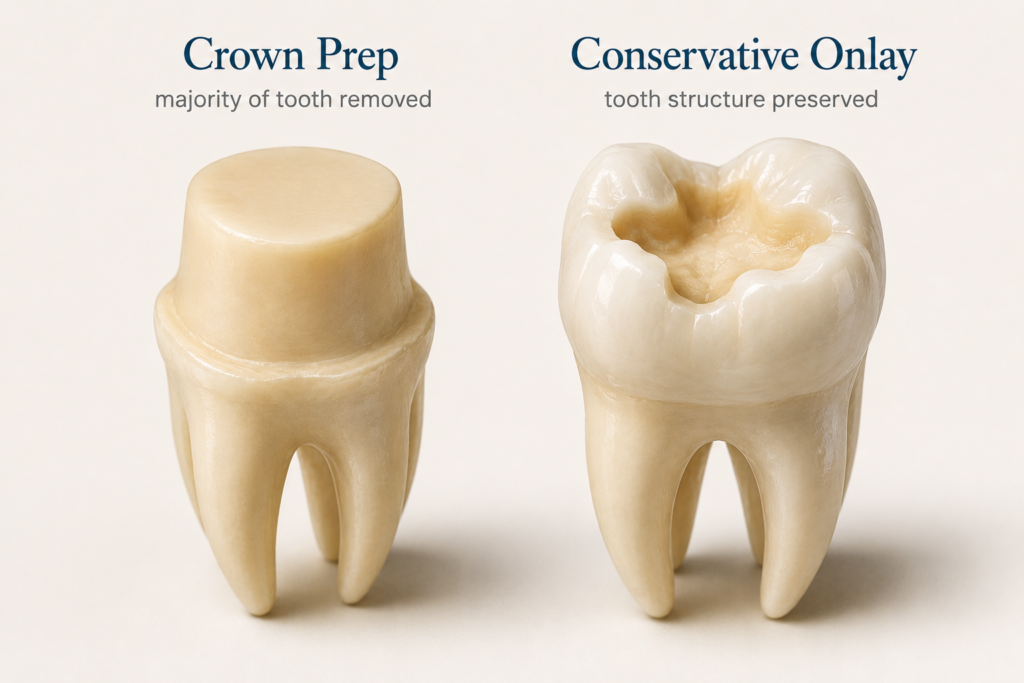
A crown is a major restoration that typically removes 60 to 75 percent of the visible tooth structure, or 100 percent of the outside of your tooth, which is the strongest part of the tooth. It is the right call for some teeth, especially after large fractures, significant decay, or to replace an existing failing crown. It is the wrong call when the same problem can be solved with proper technique using modern bonding materials, a veneer, an inlay, or an onlay that preserves far more of the natural tooth.
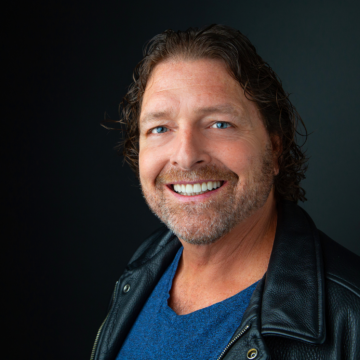
In Bend, Oregon, Dr. Phillippe “Flip” Freeman practices what is known as conservative and biomimetic dentistry. Biomimetic dentistry is a recognized school of thought, taught at training centers around the world, that focuses on rebuilding teeth in a way that mimics the natural structure, strength, and function of the original tooth.
The philosophy is simple: the most valuable thing in your mouth is the tooth you were born with. Every restoration should preserve as much of that tooth as possible. A dental crown does not.
If a dentist has recommended a crown and your gut is telling you to slow down, you are not being difficult. You are being thoughtful and cautious about your future dental needs.
Why “just crown it” became the default answer
For decades, the crown has been a workhorse of general dentistry. It was a major upgrade over large silver fillings, it is well reimbursed by insurance, and it is faster to provide than a custom conservative restoration that uses today’s bonding materials and techniques. Many practices default to crowns because the dentist was trained that way, the lab partnership is set up for it, or the schedule and profit margin reward quick decisions over conscientious ones.
None of those reasons have anything to do with what is best for the longevity of your tooth.
Here is what often gets glossed over in a five-minute consult:
- A crown requires the tooth to be reduced on every surface, all the way around. That is irreversible damage.
- Once a tooth is crowned, the long-term path usually includes future re-treatments, possible root canals, and eventually extraction. This is sometimes called the restorative cycle. Some dentists call it the “circle of death.”
- Modern adhesive dentistry, when done well, can solve many of the same problems with a fraction of the drilling or removal of your natural tooth.
The American Dental Association and major dental research bodies have shifted toward what is called Minimally Invasive Dentistry (MID), a model that emphasizes preserving healthy tooth structure whenever possible (ADA, Journal of the American Dental Association). The dentists doing this work well tend to be the ones with deep cosmetic training, because cosmetic dentistry forces you to think about how a tooth looks, functions, and ages over decades, not just whether the filling holds.
What conservative dentistry actually means
Conservative dentistry is not a marketing phrase. It is a treatment philosophy with measurable principles:
- Preserving enamel. Enamel is the strongest substance in the human body and it cannot grow back. Every millimeter you save matters.
- Match the restoration to the problem. A small chip does not need a crown. A crack in a tooth does not always need a crown. A worn edge does not need a crown. A discolored front tooth does not need a crown.
- Use adhesive techniques. Bonded restorations rely on chemistry to strengthen and hold the tooth together, not on heavy removal of tooth structure.
- Plan for the next 20 years, not the next 20 minutes. A conservative restoration today protects your options later.
This is the standard of care Dr. Freeman has built his Bend practice around. It is also why patients drive in from Sisters, Prineville, Sunriver, Redmond, and beyond for second opinions.
The smarter alternatives to a crown
Here is a plain-language look at the options a conservative dentist will usually consider before recommending a crown.
Direct composite bonding
A tooth-colored resin is sculpted directly onto the tooth and cured in a single visit. It fixes chips, small fractures, gaps, and shape issues. Often requires little to no drilling. Best for cosmetic concerns and small structural repairs.
Porcelain or composite veneers
A thin shell of porcelain or layered composite bonded to the front of the tooth. Modern minimal-prep and no-prep veneers can transform a smile while preserving most of the natural enamel. Veneers are not a crown. A veneer covers one surface, not the entire tooth.
Inlays and onlays
Custom-made restorations made from porcelain, composite, or even gold that fit into or onto the tooth, replacing only the damaged portion. An onlay can rebuild a cusp or a chewing surface without sacrificing the rest of the tooth. This is often the right answer when a problem is “too big for a filling but too small for a crown.”
Adhesive partial-coverage restorations
The middle ground between an onlay and a crown. A skilled cosmetic dentist can rebuild significant tooth structure while leaving healthy enamel and dentin in place.
When a crown really is the right call
A crown is appropriate when a tooth has lost too much structure to support a more conservative option, or when a major fracture compromises long-term stability. The point of conservative dentistry is not to avoid crowns forever. It is to make sure a crown is the answer to the question being asked.
How Dr. Freeman approaches treatment planning in Bend
Dr. Phillippe Freeman has practiced cosmetic and complex restorative dentistry for more than 30 years while adhering to conservative philosophies. He holds Fellowship and Masters Awards from the Academy of General Dentistry (AGD) and has been an active member of the American Academy of Cosmetic Dentistry (AACD) for over 25 years. Both credentials reflect thousands of hours of advanced training in restorative and cosmetic technique.
His practice in Bend, Oregon is exclusively focused on adult dentistry, with a particular emphasis on cosmetic, complex, and full-mouth cases, while still providing general dentistry. Patients come to Freeman Smiles for one of three reasons:
- They have been told they need a crown and want a second opinion on more conservative options.
- They are tired of being rushed through a chain or insurance-driven practice.
- They want a smile that looks natural, not “done,” and they want it to last.
The treatment planning approach at Freeman Smiles always starts with a full picture of your total dental condition: photos, X-rays, bite analysis, and a real conversation about the patient’s goals. Only then does treatment get recommended. Patients consistently describe the experience as calm, transparent, and unhurried. After more than three decades in practice, with a loyal patient base across Central Oregon, that consistency is the strongest credential of all.
This is what Dr. Freeman means when he says cosmetic and general dentistry should feel personal, not procedural.
Questions to ask before you agree to a crown
If a crown has just been recommended, take these questions to your next appointment. A confident dentist will welcome them.
- How much of my natural tooth structure will be removed?
- Have you considered an onlay, veneer, or bonded restoration first? Why or why not?
- What does the long-term outlook look like for this tooth with a crown versus a more conservative option?
- Do you have photos or scans of the tooth you can show me?
- What happens if I wait, monitor, and reassess in six months?
- Is the recommendation driven by structural need or by what insurance will cover?
If the answers feel rushed, vague, or one-size-fits-all, a second opinion is worth your time. It costs far less than a restoration you did not need.
Frequently asked questions
Is a crown ever the best option?
Yes. Crowns are the right answer when a tooth has lost too much structure to support a more conservative restoration, after some root canals, and for some large fractures. The issue is not crowns themselves, it is using a crown as a default when a less invasive option would work.
What is conservative dentistry?
Conservative dentistry, also called minimally invasive dentistry or biomimetic dentistry, is a treatment philosophy that prioritizes preserving natural tooth structure. It favors bonded and adhesive restorations, smaller interventions, and long-term planning over quicker options that involve aggressive reduction and that are easier to bill through insurance.
Are veneers the same as crowns?
No. A veneer covers the front surface of a tooth and is much more conservative than a crown, which covers all surfaces. A skilled cosmetic dentist can often use a veneer where another office would have recommended a crown. In most cases, either no tooth structure is removed or only a very minimal amount of structure is altered for a veneer, while a crown preparation removes the entire outside of the tooth until only a small stump is left.
How do I know if I should get a second opinion on a dental crown?
If you have been told you need multiple crowns, if the recommendation came after a quick exam, or if you were not shown photos or scans of the teeth in question, a second opinion is reasonable. Patients in Bend, Sisters, Prineville, and Sunriver regularly come to Freeman Smiles specifically for this.
Does Freeman Smiles see new patients in Bend, Oregon?
Yes. Freeman Smiles is an adult-focused cosmetic and general dental practice in Bend, Oregon, serving patients across Central Oregon. Consultations include photos, a thorough exam, and a clear, conservative treatment plan.
The bottom line
A crown is a tool, not a default. In the right situation, it may be the best thing a dentist can do for a tooth. In the wrong situation, it removes healthy structure that the patient will never get back.
If you have been handed a treatment plan that feels heavier than it should, talk to a dentist whose first instinct is to save tooth structure, not remove it. In Bend, that has been Dr. Freeman’s philosophy for more than 30 years.
Ready for a second opinion?
Schedule a consultation with Dr. Phillippe Freeman at Freeman Smiles in Bend, Oregon. Bring your X-rays, your questions, and your goals. Do not bring your previous treatment plan. Dr. Freeman will give you an unbiased plan that is not influenced by someone else’s recommendation.
Call 541-507-6453 (541-50-SMILE) or visit freemansmiles.com to book.